
Client Alert
Our March 31, 2026, Client Alert described the ERBA NPR and SA NPR issued by the federal banking agencies on March 19, 2026. In that Alert, we indicated we would issue a separate Client Alert describing in more detail how the Standardized Approach “risk weights” in Section 32 and “credit conversion factors” (CCFs) in Section 33 of the US Basel III rule would be amended by the proposals in the SA NPR and how those would differ from the risk weights and CCFs proposed in the ERBA NPR (which would be contained in proposed new Sections 111 and 112 of the US Basel III rule). This Alert provides that description and is intended to be read in conjunction with the earlier Client Alert, which provides the background, and defined terms, for this supplementary Client Alert.
This Client Alert does not address the risk weights for securitization exposures. For a discussion of the impact of the ERBA NPR and SA NPR proposals on securitization exposures under the US Basel III rule, see our March 26, 2026, Client Alert dealing with the implications of those proposals for securitization transactions, which can be found here.
Pages 2-11 of the Federal Reserve’s Regulation Q Subpart D “Standardized Approach,” linked here, contain the current Sections 32 and 33 of the US Basel III rule discussed below. The Federal Reserve’s proposed amendments to Sections 32 and 33 (Section 217.32 and .33 of the Federal Reserve’s Regulation Q) are contained on pages 15422 and 15423 of the SA NPR linked here.1 Pages 15157-15164 of the ERBA NPR, linked here, contain the proposed new Sections 111 and 112 for the US Basel III rule as part of the proposed ERB Approach discussed below.
Risk Weights Under the Proposed ERB Approach
How do risk weights in the proposed ERB Approach differ from existing risk weights in the Standardized Approach?
The Standardized Approach lists 13 categories of “exposures” for which it assigns risk weights in Section 32(a)-(m) of the US Basel III rule. The proposed ERB Approach would list 11 categories of “exposures” for which it would assign risk weights in the proposed Section 111(a)-(k) of the US Basel III rule.
The difference in the number of subsections results from the proposed ERB Approach Section 111(f) specifying risk weights for all the different forms of real estate exposures identified in Standardized Approach Section 32(g)-(j) and for some forms of real estate exposures not mentioned in Section 32. In addition, the proposed Section 111(g) would specify risk weights for “retail exposures,” which are not addressed specifically in Sections 32 of the Standardized Approach. As we note below in describing the SA NPR’s proposed changes to the existing Standardized Approach, this means retail exposures currently receive a uniform 100% risk weight, which the proposed SA NPR changes would reduce to 90%.
The existing language in the Standardized Approach’s Section 32(a), for “sovereign exposures,” 32(b), for “certain supranational entities and multilateral development banks (MDBs),” Section 32(e), for “public sector entities (PSEs),” Section 32(l), for “other assets,” and Section 32(m), for “insurance assets,” would be repeated verbatim in the ERB Approach proposed Sections 111(a), (b),2 (e), (j) and (k).3 The risk weights for these exposures would, therefore, be the same under the existing Standardized Approach and the proposed ERB Approach. As noted below, however, the SA NPR proposes to reduce from 100% to 90% the risk weight assigned to “other assets” in Section 32(l)(5), which would primarily affect the risk weight for retail exposures.
The proposed ERB Approach would assign risk weights different from the Standardized Approach to at least some exposures in each of the broad categories of exposures covered by Sections 32(c)-(d), and (f)-(g) of the Standardized Approach.4 Thus, Sections 111(c)-(d), and (f)-(h) of the proposed ERB Approach would assign risk weights different from the Standardized Approach to:
- subordinated exposures to GSEs, banks, and corporations;
- exposures to banks based on their investment grade and capital compliance status;
- real estate exposures based on factors not mentioned in the existing Standardized Approach, but some of which would be added to the Standardized Approach through proposals in the SA NPR for “residential mortgage exposures;
- ”retail exposures, which the Standardized Approach does not specifically address, but which would have their risk weights reduced indirectly by the proposal in the SA NPR to reduce from 100% to 90% the risk weight for “other assets” in Section 32(l)(5) of the Standardized Approach; and
- corporate exposures based on investment grade, project finance, and subordination status, none of which status is addressed in the Standardized Approach, which assigns a 100% risk weight to all forms of corporate exposures, but the SA NPR proposes to reduce from 100% to 95% the risk weight for all corporate exposures.
How would the proposed ERB Approach risk weight exposures to GSEs differently than the Standardized Approach?
The proposed ERB Approach would assign a 150% risk weight to a “subordinated exposure” to a GSE5 other than a Federal Home Loan Bank (FHLB) or the Federal Agricultural Mortgage Corporation (Farmer Mac), which subordinated exposures would receive the same 20% risk weight as under the Standardized Approach.6 The Standardized Approach makes no distinction between senior and subordinated debt issued by any obligor. It only addresses subordinated exposures in its treatment of securitization exposures. Otherwise, like the Standardized Approach, the proposed ERB Approach would assign a 20% risk weight to all other GSE debt.
Also like the Standardized Approach, the proposed ERB Approach would assign a special 20% risk weight to exposures to preferred stock in an FHLB or Farmer Mac under the Simple Risk-Weight Approach for equity exposures,7 but it would also assign that 20% risk weight to an exposure to preferred stock in an FHLB or Farmer Mac that is not an equity exposure, because it would treat such exposure as a subordinated exposure to the FHLB or Farmer Mac. Such a subordinated exposure to any other GSE would be assigned a 150% risk weight.8 Exposures to preferred stock equity interests in such other GSEs would be assigned a 100% risk weight as under the Standardized Approach.9
How would the proposed ERB Approach risk weight exposures to US banks differently than the Standardized Approach?
The Standardized Approach risk weights all exposures to US banks (meaning depository institutions, not BHCs) at 20%. The proposed ERB Approach would risk weight an exposure to a US bank at 30%, 40%, 75%, or 150% depending upon the type of exposure and a combination of the investment grade status and capital rule compliance of the relevant bank. Unlike the Standardized Approach, the proposed ERB Approach does not separately assign risk weights to US and foreign banks, as Section 32(d)(1) and (2) do under the Standardized Approach, but the proposal would treat foreign bank exposures differently in the manner described below in our answer to the next question.
The proposed ERB Approach would divide US banks into three categories10:
- Grade A Banks: banks that are investment grade (as currently defined in the US Basel III rule) and meet all applicable minimum capital and capital buffer requirements, so that the bank is not subject to limitations on distributions and discretionary bonus payments, and is “well capitalized” under “prompt corrective action” (PCA) standards.
- Grade B Banks: banks that are not Grade A banks, but are either investment or speculative grade, meet all minimum capital requirements, and are categorized as at least “adequately capitalized” under PCA.
- Grade C Banks: banks that are neither Grade A nor Grade B, which includes all banks that have not disclosed their capital ratios in the past 6 months or for which an external auditor has issued an adverse opinion or, in the past 12 months, has expressed substantial doubt about the ability of the bank to continue as a going concern.
The general risk weight for US (1) Grade A Bank exposures would be 40%, (2) Grade B Bank exposures would be 75%, and (3) Grade C Bank exposures would be 150%, subject to the special risk weights for subordinated exposures to US banks and for exposures to a “covered debt instrument” for which a US bank is the obligor.11
The agencies, however, propose a special 30% risk weight for Grade A Bank exposures for any such US bank that has a common equity tier 1 (CET 1) capital ratio of 14% and a leverage ratio of 5%, but if such Grade A Bank is a Category I, II, or III bank it must have a 5% supplementary leverage ratio rather than a 5% leverage ratio.12 The agencies state that 68.3% of all US banks (“depository institutions”) would receive this special 30% risk weight based on June 30, 2025, Call Report data.13
This special 30% risk weight was not included in the agencies’ 2023 proposal for a different ERB Approach. It is also not included in the Basel Framework that is the source for grading bank exposures from A-C.14
Exposures to US banks would, therefore, receive higher risk weights than under the universal 20% risk weight that applies to all US banks under the Standardized Approach.
In addition, the agencies propose to assign a 150% risk weight to a subordinated exposure15 to a US bank and to a US bank exposure that is an exposure to a “covered debt instrument”16 (such as TLAC or equivalent “bail-in equity”17).
How would the proposed ERB Approach risk weight exposures to non-US banks differently than the Standardized Approach?
The Standardized Approach assigns different risk weights to non-US bank exposures based upon the CRC (country rating classification), Sovereign Default, and OECD membership status of the bank’s home country.18 For banks from OECD member countries, this produces the same uniform 20% risk weight for all exposures to such banks as US bank exposures receive under the Standardized Approach.19
Except for certain trade credits described below, the proposed ERB Approach would assign to foreign bank exposures (including subordinated exposures) the same risk weights as described above for US banks, with Grade A-C Bank exposure status determined by the same criteria as for US banks, except the foreign bank’s capital compliance would be computed according to its home country’s rules, so long as such rules are “in broad agreement with” the Basel Framework.20
The special 30% risk weight for certain Grade A banks would apply to a foreign Grade A bank that has a CET 1 capital ratio of at least 14% and a leverage ratio of at least 5% “under the capital requirements imposed by the home country supervisor on that foreign bank.”21
The proposed ERB Approach (like the agencies’ 2023 proposal for a different ERB Approach) would assign a special 20% risk weight for a foreign Grade A bank “exposure that is a self-liquidating, trade-related contingent item that arises from the movement of goods and that has a maturity of three months or less” (Trade Credit).22 This special 20% risk weight would apply to all foreign (but not US) Grade A bank Trade Credit exposures, including those to foreign Grade A banks not eligible for the special 30% risk weight available only to Grade A banks meeting the capital criteria described above.23
Trade Credit exposures to Grade B foreign banks would receive a special 50% (rather than 75%) risk weight, while all exposures to Grade C foreign banks, including Trade Credit exposures, would receive the same 150% risk weight.24
Finally, risk weights for exposures to a foreign bank would have a “floor” equal to the risk weight assigned to the foreign bank’s home country.25 This would indirectly incorporate into foreign bank risk weights, as a minimum “floor” risk weight only, the CRC determined risk weights for sovereigns in Table 1 to proposed Section 111(a). This floor, however, would not apply to Trade Credit exposures, exposures in the local currency of the home country of the foreign banks, and exposures to a branch of the foreign bank located outside its home country and in the local currency of the country in which the branch is located (e.g., a USD obligation of a US branch of a foreign bank).26
Overall, therefore, the proposed risk weights for foreign bank exposures (like the proposed risk weights for US bank exposures) would be higher than the 20% risk weight assigned by the Standardized Approach to all exposures to banks (including US banks) in OECD member countries, except for the special 20% risk weight described above that applies to Trade Credit exposures to Grade A foreign banks.
The separate risk weights for US and foreign banks in the Standardized Approach (which in practice is separate treatment only for banks from non-OECD countries) would not exist in the proposed ERB Approach, except for the “home country floor” described above and the special risk weights for Trade Credit exposures to foreign Grade A and B banks also described above.
The proposed risk weights for both US and foreign banks are the same as proposed in 2023, except that the 2023 proposed ERB Approach did not include the special 30% risk weight for certain Grade A bank exposures, so that all Grade A bank exposures (other than foreign Grade A bank Trade Credit exposures) were assigned a 40% risk weight.
Similarly, the Basel Framework does not provide the special 30% risk weight for certain Grade A bank exposures.27 Importantly, however, the Basel Framework provides special, lower, risk weights for all bank Trade Credit exposures, not only for such exposures to foreign banks.28
How would the proposed ERB Approach risk weight real estate exposures differently than the Standardized Approach?
The Standardized Approach assigns different risk weights to four types of real estate exposures:
- Residential mortgage exposures (Section 32(g)): 50% risk weight for first-lien mortgage on owner-occupied (or rented) property on loan made in accordance with prudent underwriting standards that is not 90 days or more past due, in nonaccrual status, or either restructured or modified. 100% risk weight for junior lien and any first lien residential mortgage exposure that does not meet all such criteria (including a past due first lien mortgage).
- Pre-sold construction loans (Section 32(h)): 50% for non-cancelled and 100% for cancelled purchase contracts.
- Statutory multifamily mortgage exposures29 (Section 32(i)): 50%.
- High volatility commercial real estate (HVCRE) exposures30 (Section 32(j)): 150%.
Other than residential mortgage exposures (which receive a 100% risk weight when in default), past due exposures listed above would receive a 150% risk weight under Section 32(k). Any real estate exposure not past due and not described above, would receive a 100% risk weight under Section 32(l)(5) as an asset “not specifically assigned a different risk weight.” The SA NPR proposes to reduce to 90% that risk weight.
The SA NPR also proposes to amend Section 32(g) to assign risk weights lower or higher than (or, for regulatory residential real estate exposures dependent on cash flows with an LTV ratio greater than 60% and less than or equal to 80%, the same) 50% for residential loans that meet the “loan to value” percentages described below for the ERB Approach. We compare those proposed risk weights below where we describe the ERB Approach proposed risk weights.
The proposed ERB Approach would assign risk weights to eight types of real estate exposures31:
- Statutory multifamily mortgage exposures (Section 111(f)(1)): Same 50% as Standardized Approach, so long as not a past due real estate exposure.
- Pre-sold construction loans (Section 111(f)(2)): Same 50% for uncancelled (so long as not a past due real estate exposure) and 100% for cancelled as Standardized Approach.
- HVCRE exposures (Section 111(f)(3)): Same 150% as Standardized Approach.
- Acquisition, development, or construction (ADC) exposures that are not HVCRE exposures32 (Section 111(f)(4)): 100%.
- Regulatory residential real estate exposures (Section 111(f)(5)) defined33 somewhat differently than the 50% risk weighted residential real estate exposures described in Section 32(g)(1) of the Standardized Approach:
Instead of the current Standardized Approach Section 32(g)(1) risk weights of 50% for most first-lien mortgages and 100% risk weight for some first lien mortgages and all junior lien mortgages, the ERB NPR proposes different risk weights based on specified characteristics that would also be added to the Standardized Approach through the amendments proposed in the SA NPR.
- If not “cash flow dependent,” according to “loan to value” (LTV) status, as specified in Table 5 to Section 111 of the proposed ERB Approach rule:
Table 5 to § _.111-Risk Weights for Regulatory Residential Real Estate Exposures Not Dependent on Real Estate Cash Flows
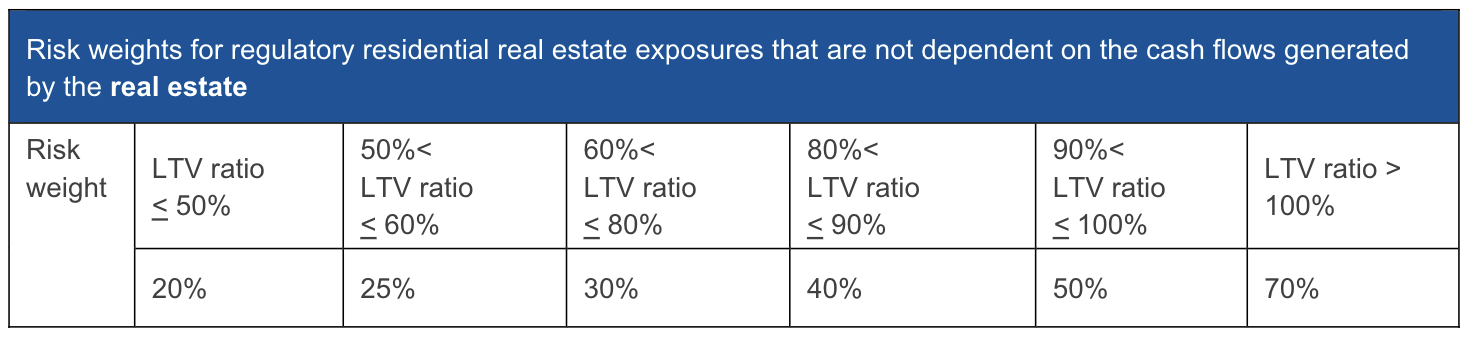
All of these proposed risk weights are 20% lower than in the agencies’ 2023 proposal, which proposed risk weights ranging from 40% to 90% for the same six categories.
These proposed risk weights, however, are identical to those in the Basel Framework.34
As described below, the SA NPR proposes to use the same categories for assigning risk weights ranging from 25% to 75% under the Standardized Approach to regulatory real estate mortgage exposures not dependent on real estate cash flows, so that for each category the Standardized Approach risk weight would be 5% more than above in Table 5 for the proposed ERB Approach.
- If dependent upon “cash flow,” according to “loan to value” (LTV) status, as specified in Table 6 to the proposed ERB Approach rule:
Table 6 to § _.111-Risk Weights for Regulatory Residential Real Estate Exposures Dependent on Real Estate Cash Flows
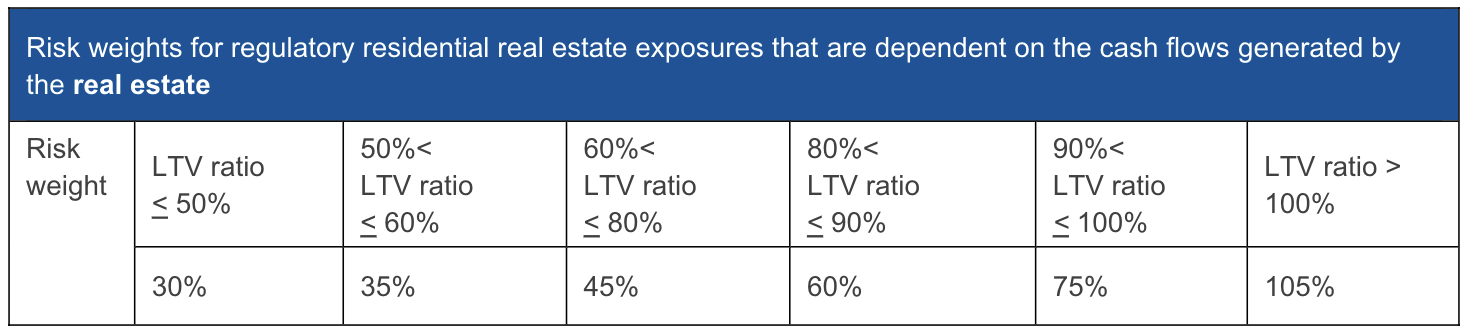
Again, these risk weights are all 20% less than in the agencies’ 2023 proposal, which proposed a range from 50% to 125%. Also again, these risk weights are identical to those in the Basel Framework.35
As described below, the SA NPR proposes to amend the Standardized Approach to use the same categories for assigning risk weights to residential real estate mortgage exposures dependent on real estate cash flows that would range from 35% to 110%, which, again, would be 5% higher in each category than proposed for the ERB Approach.
Under the proposed rule, a regulatory residential real estate exposure would be “dependent on the cash flows generated by the real estate” if the bank holding the exposure had treated “the cash flows generated by lease, rental, or sale of the real estate securing the loan as a source of repayment” in its underwriting of the exposure at origination, but a loan secured by the borrower’s principal residence would not qualify, so that its risk weight would always be determined by the lower risk weights assigned by Table 5 above for regulatory residential real estate loans not dependent on real estate cash flows.36
Regulatory commercial real estate exposures37 (Section 111(f)(6)): Because the Standardized Approach does not assign risk weights specifically to commercial real estate exposures other than HVCRE exposures, such exposures other than HVCRE exposures all receive a 100% risk weight as unenumerated exposures under Section 32(l)(5) or, if past due, a risk weight assigned under Section 32(k). Because the SA NPR proposes to reduce the Section 32(l)(5) risk weight from 100% to 90%, commercial real estate loans would generally receive a 90% risk weight under the Standardized Approach, if the proposal is adopted.
As with regulatory residential real estate exposures, under the proposed ERB Approach risk weights would vary depending upon (1) whether the exposure is “cash flow dependent” and (2) LTV ratios.
- For non-cash flow dependent exposures, Table 7 to the ERBA NPR proposed ERB Approach rule assigns risk weights as follows:
Table 7 to § _.111-Risk Weights for Regulatory Commercial Real Estate Exposures Not Dependent on Real Estate Cash Flows

- For cash flow dependent regulatory commercial real estate exposures, Table 8 to the ERBA NPR proposed ERBA rule assigns risk weights as follows:
Table 8 to § _.111-Risk Weights for Regulatory Commercial Real Estate Exposures Dependent on Real Estate Cash Flows

These are the same risk weights as proposed by the agencies in 2023. They are also the same as in the Basel Framework.38
- Other real estate exposures (Section 111(f)(7)): Because the Standardized Approach does not assign a risk weight to such unmentioned exposures, such exposures all receive a 100% risk weight as unenumerated exposures under Section 32(l)(5) or, if past due, a risk weight assigned under Section 32(k). Of course, the SA NPR proposes to reduce to 90% the Section 32(l)(5) risk weight.
Under the proposed ERB Approach, such unmentioned exposures would be assigned a 150% risk weight, unless the exposure is a residential mortgage exposure that is not dependent on the cash flows generated by the real estate, which must be assigned a 100% risk weight.
- Past due real estate exposures (Section 111(f)(8)): Under the Standardized Approach, Section 32(k) assigns a 150% risk weight to a real estate exposure 90 days or more past due or on nonaccrual, except a residential mortgage exposure (and other exposures not relevant for real estate exposures). For residential real estate exposures that are 90 days past due or on nonaccrual, Section 32(g)(2) assigns a 100% risk weight.
Under the proposed ERB Approach, Section 111(f)(8) would assign a 150% risk weight to a real estate exposure that is 90 days past due or on nonaccrual, except a residential mortgage exposure that is not dependent on the cash flows generated by the real estate, which would be assigned a 100% risk weight.
What is a retail exposure under the proposed ERB Approach?
Section 101 of the proposed ERB Approach defines a retail exposure as an exposure that is not a real estate exposure and that is either: (1) an exposure to a natural person or persons, or (2) an exposure to a small or medium sized enterprise that satisfies the criteria in the definition of regulatory retail exposure.39
How would the proposed ERB Approach risk weight retail exposures differently than the Standardized Approach?
The Standardized Approach does not assign risk weights to, or even mention, retail exposures. Such exposures would receive a 100% risk weight under the existing Standardized Approach either because they would be corporate exposures or exposures not mentioned in Section 32, which therefore automatically receive a 100% risk weight under Section 32(l)(5). As described below, the SA NPR proposes to reduce to 95% the risk weight for corporate exposures and to 90% the risk weight for exposures not specifically assigned a risk weight in other parts of Section 32.40
The proposed ERB Approach Section 111(g) would assign risk weights of:
- 75% to a “regulatory retail exposure”41 that is not a “transactor exposure.”42
- 45% to a regulatory retail exposure that is a transactor exposure.
- 100% to all other retail exposures (i.e., all retail exposures that are not regulatory retail exposures).43
These three proposed risk weights are all 10% lower than the percentages proposed in 2023, which were 85%, 55% and 110%. The proposed risk weights, however, are identical to those in the Basel Framework.44
How would the proposed ERB Approach risk weight corporate exposures differently than the Standardized Approach?
The Standardized Approach currently risk weights all corporate exposures45 at 100%, except exposures to a “qualified central counterparty” (QCCP), which receive a 2% or 4% risk weight depending upon the type of cash collateral transaction posting that creates the exposure. As mentioned above, the SA NPR proposes to reduce this corporate risk weight to 95%.
The proposed ERB Approach would assign a 100% risk weight to any corporate exposure other than:
- “a corporate exposure to a company that is investment grade,” which would receive a 65% risk weight, so long as the exposure is not a subordinated exposure, under proposed Section 111(h)(1).46
- “a project finance exposure that is not a project finance operational phase exposure,” which would receive a 130% risk weight. (Section 111(h)(3)(ii)), unlike the 100% risk weight assigned to a project finance operational phase exposure under proposed Section 111(h)(3)(i).47
- QCCP exposures, which would receive the same risk weights as in the Standardized Approach under proposed Section 111(h)(4).48
- A subordinated exposure or an exposure to a “covered debt instrument,” both of which would receive a 150% risk weight under proposed Section 111(h)(5). A “covered debt instrument” would be TLAC or equivalent debt, as currently defined in the US Basel III rule to deal with G SIB issued instruments designed to function as “bail-in equity.”49
Risk Weights Changes Proposed for the Standardized Approach
What changes to Standardized Approach risk weights are proposed in the SA NPR?
The SA NPR proposes to reduce from 100% to 95% the risk weight for all non-QCCP corporate exposures under Section 32(f)(1) of the US Basel III rule.50
The SA NPR proposes to amend Section 32(l)(5) of the US Basel III rule to reduce from 100% to 90% the risk weight assigned to “all assets not specifically assigned a different risk weight under” the Standardized Approach and “not deducted from tier 1 or tier 2 capital pursuant to” Section 3.22 of the Basel III rule.51
Finally, the SA NPR proposes to incorporate into Section 32(g) of the US Basel III rule the same two charts for Regulatory Residential Real Estate Exposures, retitled as Residential Mortgage Exposures, and assign to such exposures risk weights in all cases 5% higher than those proposed for the ERB Approach. Thus, “Residential Mortgage Exposures that Are Not Dependent on the Cash Flows Generated by the Real Estate” would receive risk weights ranging from 25% to 75% using the same LTV categories as in Table 5 above on page 5 of this Alert. “Residential Mortgage Exposures Dependent on the Cash Flows Generated by the Real Estate” would receive risk weights ranging from 35% to 110% using the same LTV categories as in Table 6 on page 5 of this Alert.52
Credit Conversion Factors Under the Proposed ERB Approach and the SA NPR
How would the proposed ERB Approach treat off-balance sheet exposures differently from the Standardized Approach in assigning “credit conversion factors” (CCFs) for establishing the “credit equivalent amounts” of off-balance sheet exposures and how would the SA NPR propose to change those Standardized Approach CCFs?
The existing Standardized Approach assigns CCFs of 0%, 20%, 50%, and 100% to four separate categories of off-balance sheet exposures enumerated in Section 33 of the US Basel III rule. The proposed ERB Approach would assign CCFs of 10%, 20%, 40%, 50%, and 100% to four separate categories of off-balance sheet exposures under Section 112 proposed in the ERBA NPR.
The current Standardized Approach CCF categories are:
- 0%: for the unused portion of an unconditionally cancelable commitment.
- 20%: for the amount of commitments with an original maturity of one year or less that are not unconditionally
cancelable and for Trade Credits; - 50%: for the amount of commitments with an original maturity of more than one year that are not unconditionally
cancelable and for “transaction-related” contingent items (such as performance bonds or letters of credit, as
opposed to financial letters of credit). - 100%: for financial letters of credit and other items (such as representations and warranties) that function as
guarantees, plus repurchase or forward agreements.53
The SA NPR proposes to eliminate the 0% category and replace it with a 40% CCF for all commitments, which would mean commitments of more than one year would be removed from the 50% CCF category and placed in the new 40% CCF category along with short term commitments. All commitments (other than unconditionally cancelable commitments with a 0% CCF and both “note issuance facilities” (NIFs) and “revolving underwriting facilities” (RUFs), which would continue to be assigned a 50% CCF) would receive the same 40% CCF.54 The SA NPR would expressly assign NIFs and RUFs to the 50% CCF category, along with the “transaction-related” contingent items currently in that category, which is consistent with the proposed ERB Approach described below in preserving the existing 50% CCF for such commitments.55
The proposed ERB Approach CCF categories would be:
- 10%: for the unused portion of an unconditionally cancelable commitment.
- 20%: for the amount of each Trade Credit exposure.
- 40%: for all commitments, regardless of maturity, that do not qualify for a lower (see 10%) or higher (see 50% for NIFs and RUFs).
- 50%: for “transaction-related” contingent items (such as performance bonds or letters of credit, as opposed to financial letters of credit) plus NIFs and RUFs.
- 100%: for financial letters of credit and other items (such as representations and warranties) that function as guarantees, plus repurchase or forward agreements.56
Compared to the existing Standardized Approach, the proposed ERB Approach would, therefore, apply higher CCFs to unconditionally cancelable commitments (10% versus 0%) and to short term commitments (40% versus 20%) and a lower CCF (40% versus 50%) to long term commitments. The latter two differences, however, would be eliminated if the CCFs proposed in the SA NPR are enacted, which would leave the Standardized Approach’s 0% CCF for unconditionally cancelable commitments as the only difference from the ERBA NPR’s proposed CCFs.
The SA NPR proposes an amendment to the existing definition of “commitment” (which, as an amendment to the US Basel III rule Section 2 definitions would also apply to the proposed ERB Approach) to explicitly state the definition includes an “unconditionally cancelable” contractual arrangement.57
The SA NPR also proposes to amend the existing Section 33(a) by adding a clause (5) rule for computing the amount of a commitment without an express contractual maximum amount based on the highest drawn amount over the past 24 months or, if a shorter period, since the commitment was created.58 The ERBA NPR proposes the same computation method for retail commitments without an express maximum amount under Section 112(a)(5) of the proposed ERB Approach.59
- Substantively identical OCC and FDIC proposed amendments to their Standardized Approach regulations are also contained in the SA NPR.
- Instead of listing the “certain supranational entities” listed in Section 32(b) of the US Basel III rule, proposed Section 11 1(b) uses the defined term “specified supranational entities” that specifies the same six supranational entities listed in Section 32(b).
- Proposed Section 111(1) for “past due exposures” is substantively equivalent to the Standardized Approach Section 32(k) with the same caption, except Section 32(k) excludes a sovereign, real estate, and policy loan exposure from the standard 150% risk weig ht and the proposed Section 111(i) only excludes sovereign and real estate exposures. Both Section 32(m)(2) of the Standardized Approach and the proposed Section 111(k)(2) assign a 20% risk weight to policy loans reported by a BHC. Section 2 of the US Basel III rule defines a “policy loan” as “a loan by an insurance company to a policyholder pursuant to the provisions of an insurance contract that is secured by the cash surrender value or collateral assignment of the related policy or contract. A policy loan includes: (1) A cash loan, including a loan resulting from early payment benefits or accelerated payment benefits, on an insurance cont ract when the terms of contract specify that the payment is a policy loan secured by the policy; and (2) An automatic premium loan, which is a loan that is made in accordance with policy provisions which provide that delinquen t premium payments are automatically paid from the cash value at the end of the established grace period for premium payments. It is possible the agencies omitted policy loans from the Section 111(i) exclusions by mistake. They do not mention policy loans in the preamble to the ERBA NPR, but the proposed ERB Approach treats policy loans the same as the Standardized Approach, except by not excluding such loans from the proposed 150% risk weight for “past due exposures.” The agencies’ 2023 ERB Approach proposal treated “defaulted exposures” differently from the Standardized Approach, but contained the same “policy loan” exclusion that would leave a defaulted “policy loan” with the same 20% risk weight as under Section 32(m)(2) of the Standardized Approach.
- See page 14964 of the ERBA NPR (“Relative to the current standardized approach, the proposal would incorporate more granular risk factors to allow for a broader range of risk weights. Specifically, the expanded risk-based approach would introduce new risk weights for exposures to depository institutions, foreign banks, and credit unions; subordinated exposures, including those to GSEs; and real estate, retail, and corporate exposures.”) Because the SA NPR proposes reducing to 90% the risk weight assigned by Section 32(l)(5) to “assets not assigned a different risk weight” and the proposed Section 111(l)(5) would assign the same 100% risk weight to such assets as the existing Standardized Approach, this proposed SA NPR change would create another difference between the proposed ERB Approach risk weights and such revised Standardized Approach risk weights.
- See page 15158 of the ERBA NPR, proposed Section 111(c)(2).
- Id. (proposed Section 111(c)(3)).
- This is for the “Simple Risk-Weight Approach” for equity interests in proposed Section 141, with FHLBs and Farmer Mac in the Section 141(b)(2) 20% risk weight category and other GSEs in the (b)(3)(iii) 100% risk weight category. Proposed Section 111(c)(1)(i) excludes a GSE equity exposure (and, in any case, proposed Section 110(a)(1)(v), like Standardized Approach Section 31(a)(1)(v), excludes equity exposures (other than an equity derivative contract) from “general credit risk” computations of risk weighted assets), so that proposed Section 141 would risk weight such exposures. Although Section 32(c) in the Standardized Approach assigns a 100% risk weight to all preferred stock of a GSE, Section 31(a)(1)(v) excludes equity interests from the Section 32 computations of general risk weights. Section 52(b)(2) specifically assigns a 20% risk weight to any equity interest in a FHLB or Farmer Mac under the same SSRWA as proposed for the ERB Approach. The agencies state on page 14964 of the ERBA NPR that the proposed special 20% risk weight for preferred stock and other equity interests in an FHLB or Farmer Mac “is consistent with the current standardized approach.” The proposed “subordinated exposure” definition on page 15157 of the ERBA NPR, however, includes “preferred stock that is not an equity exposure.” Because the proposed ERB Approach assigns a 20% risk weight to such a subordinated exposure and the Standardized Approach does not, the Section 32(c)(2) 100% risk weight for GSE preferred stock would apply to such preferred stock that is not an equity interest in an FHLB or Farmer Mac.
- Proposed Section 111(c)(2) on page 15158 of ERBA NPR.
- Sections 32(c)(2) and 52 of US Basel III rule for Standardized Approach and proposed Section 141(b)(3) of ERB Approach on pages 15186-87 of ERBA NPR.
- The categories appear in Table 2 to Section 111 on ERBA NPR page 15159. The proposed definitions of bank exposure “grades” are in proposed Section 101 on ERBA NPR page 15155.
- ERBA NPR at pages 15158-59, proposed Section 111(d)(1).
- ERBA NPR at page 15159, proposed Section 111(d)(2), with the special 30% risk weight appearing in Table 2 to Section 111 on t he same page 15159 under Grade A Bank Exposure.
- ERBA NPR at page 14965.
- See Table 7 in Basel Framework at page 260 https://www.bis.org/baselframework/BaselFramework.pdf.
- The proposed “subordinated exposure” definition is on ERBA NPR page 15157, as referenced above in endnote 7.
- ERBA NPR at page 15159, proposed Section 111(d)(4)(ii).
- See the definition in Section 217.2 of the Federal Reserve’s Regulation Q https://www.ecfr.gov/current/title-12/chapter-II/subchapter-A/part-217/subpart-A/section-217.2.
- US Basel III rule Section 32(d)(2) and Table 2 referenced in clause (i).
- An exposure to a bank from an OECD member country could receive a higher risk weight if that country received a CRC rating highe r than 1 or fell into Sovereign Default. As a practical matter, OECD countries do not receive CRC ratings. Banks from all such countries, therefore, receive a 20% risk weight, because their home countries are OECD members “without CRC” ratings. So long as OECD member countries do not receive CRC ratings, exposures to their banks would continue to receive a uniform 20% risk weight, except for banks from an OECD member country that fell into Sovereign Default status. No OECD member country has entered Sovereign Default status.
- ERBA NPR at pages 14966 (for the explanation) and 15115 (for clauses (1)(i) and (2)(iiii) in the proposed Section 101 definitions for Grade A and B bank exposures).
- ERBA NPR at page 15159, proposed Section 111(d)(2)(ii)(D).
- ERBA NPR at page 15159, proposed Table 2.
- This proposed provision mirrors the exception in Section 32(d)(2)(iii) of the US Basel III rule, which grants a 20% risk weig ht to a Trade Credit exposure “to a foreign bank whose home country has a CRC of 0, 1, 2, or 3, or is an OECD member with no CRC.” Without this exception the exposure to a foreign bank whose home country has a CRC of 2 would receive a 50% risk weight and the exposure to a foreign bank whose home country has a CRC of 3 would receive a 100% risk weight. The agencies appear to note this in stating on page 14966 of the ERBA NPR that “[t]he proposed approach to providing a preferential risk weight for short term self-liquidating, trade-related contingent items would be consistent with the current standardized approach.” The important difference is that this exception assigns such trade credit exposure the same 20% risk weight that applies generally to all exposures to a bank whose home country is a member of the OECD. Because the pro posed ERB Approach sets at 30% the minimum risk weight for exposures to banks from OECD member countries, this special 20% risk weight for Trade Credit to foreign Grade A bank exposures creates a lower risk weight for such exposures to foreign rather than US banks.
- Id.
- ERBA NPR at page 15159, proposed Section 111(d)(3).
- ERBA NPR at page 15159, proposed Section 111(d)(3)(i)-(iii).
- See Basel Framework Table 7 on page 260.
- Id.
- As defined in Section 2 of the US Basel III rule.
- As defined in Section 2 of the US Basel III rule.
- See ERBA NPR pages 15160-62.
- See the definition on page 15155 of the ERBA NPR, which specifies “Acquisition, development, or construction exposure (ADC) exposure means a loan secured by real estate for the purpose of acquiring, developing, or constructing residential or commercial real estate properties, as well as all land development loans, and all other land loans.” The Standardized Approach does not mention ADC exposures. On ERBA NPR page 14973, the agencies explain that the proposed ERB Approach “would be consistent with the current standardized approach, as ADC exposures are generally subject to a risk weight of 100% or more under the current standardized approach.” Under the current Standardiz ed Approach, an ADC exposure could be an HVCRE exposure, assigned a 150% risk weight under Section 32(j), a past due exposure, generally assigned a 150% risk weight under Section 32(g), or an asset “not specifically assigned a different risk weight,” assigned a 100% risk weight under Section 32(l)(5), which risk weight the SA NPR proposes to reduce to 90%.
- See the definition on page 15156-57 of the ERBA NPR, which specifies the exposure: (i) Is secured by a property that is either owner-occupied or rented; (ii) Is made in accordance with prudent underwriting standards, including standards relating to the loan amount as a percent of the value of the property; (iii) During underwriting of the loan, the [BANKING ORGANIZATION] must have applied underwriting policies that took into account the ability of the borrower to repay in a timely manner based on clear and measurable underwriting standards that enable the [BANKING ORGANIZATION] to evaluate these credit factors; (iv) The property must be valued in accordance with Section 5 of the US Basel III rule, and (v) Involves a loan that has not been restructured or modified, provided that a loan modified or restructured solely pursuant to the US Treasury's Home Affordable Mortgage Program is not modified or restructured for purposes of this section. At page 15407 of the SA NPR, the agencies propose to amend Section 32(g)(1) to conform more closely to these criteria, but they do not include clause (iii) or its equivalent.
- See Table 11 on page 288.
- See Table 12 on page 290.
- See page 15155 of the ERBA NPR for the definition proposed to be inserted into Section 101(b) of the US Basel III rule: Dependent on the cash flows generated by the real estate means, for a real estate exposure, for which the underwriting, at the time of origination, includes the cash flows generated by lease, rental, or sale of the real estate securing the loan as a source of repayment. For purposes of this definition, a residential mortgage exposure that is secured by the borrower’s principal residence is deemed not dependent on the cash flows generated by the real estate. Page 15436 of the SA NPR proposes a slightly differently worded definition be inserted into Section 2 of the Federal Reserve’s US Basel III rule (12 CFR Section 217.2) and the other two agencies propose the same change to Section 2 of their US Basel III ru les in the SA NPR.
- See page 15156 of the ERBA NPR for the definition proposed to be inserted into Section 101(b) of the US Basel III rule: Regulatory commercial real estate exposure means a real estate exposure that is not a regulatory residential real estate exposure, an ADC exposure, a pre-sold construction loan, a statutory multifamily mortgage, or an HVCRE exposure, and that meets the following criteria: (1) The exposure must be primarily secured by fully completed real estate; (2) The [BANKING ORGANIZATION] holds a first priority security interest in the property that is legally enforceable in all re levant jurisdictions; provided that when the [BANKING ORGANIZATION] also holds a junior security interest in the same property and no other party holds an intervening security interest, the [BANKING ORGANIZATION] must treat the exposures as a single regulatory commercial real estate exposure; (3) The exposure is made in accordance with prudent underwriting standards, including standards relating to the loan amount a s a percent of the value of the property; (4) During underwriting of the loan, the [BANKING ORGANIZATION] must have applied underwriting policies that took into account the ability of the borrower to repay in a timely manner based on clear and measurable underwriting standards that enable the [BANKING ORGANIZATION] to evaluate relevant credit factors; and (5) The property must be valued in accordance with §___.5; and (6) Involves a loan that has not been restructured or modified.
- See Tables 13 and 14 on pages 290-91.
- See page 15157 of the ERBA NPR for the definition.
- Under Section 32(l)(5) of the Standardized Approach, a banking organization must assign a 100% risk weight to all assets that are not assigned a different risk weight under the Standardized Approach and that are not required to be deducted from capital.
- A “regulatory retail exposure” is defined in Section 101 of the proposed ERB Approach (page 15157 of the ERBA NPR) as a retail exposure that meets all of the following criteria: (1) The exposure is a revolving credit or line of credit, or a term loan or lease; (2) The sum of the exposure amount and the amounts of all other retail exposures to the obligor and to its affiliates does no t exceed $1 million; and (3) notwithstanding (1) and (2) above, if a retail exposure exceeds 0.2 percent of the banking organization’s total retail ex posures that meet criteria (1) and (2) above, only the portion up to 0.2 percent of the banking organization’s total retail exposures may be considered a regulatory retail exposure. For purposes of clause (3), off-balance sheet exposures are measured by applying the appropriate credit conversion factor and defaulted exposures are excluded.
- On page 15157 of the ERBA NPR, the agencies propose to add into Section 101 of the US Basel III rule a definition of “transactor exposure” as a regulatory retail exposure that is a credit facility where the balance has been repaid in full at each scheduled repayment date for the previous 12 months or an overdraft facility where there has been no drawdown over the previous 12 months.
- See ERBA NPR pages 14973-74 for the agencies’ explanation and page 15162 for the proposed Section 111(g) rule text.
- See paragraph 20.68 on page 279.
- Corporate exposures do not include exposures to GSEs, banks, or other types of obligors specifically mentioned in Section 32 that are organized as corporations.
- See page 15162 of the ERBA NPR for the proposed Section 111(h) full assignment of risk weights to corporate exposures.
- Id.
- Id.
- Id.
- See page 15423 of the SA NPR for proposed amendment to Section 32(f)(1) of the US Basel III rule.
- See page 15424 of the SA NPR for the proposed amendment to Section 32(l)(5) of the US Basel III rule.
- See pages 15423-24 of the SA NPR for the proposed amendments to Section 32(g) of the US Basel III rule.
- US Basel III rule Section 33(b)(i)-(iv).
- See page 15424 of the SA NPR proposed amendment to Section 33(b) of the US Basel III rule.
- The Standardized Approach currently does not mention RUFs or NIFs. As “commitments” longer than one year, they receive a 50% risk weight. The SA NPR places those facilities into the 50% CCF category to prevent them from receiving a 40% CCF as commitments.
- See ERBA NPR page 15163-64 for the proposed Section 112(b)(1)-(5) CCFs.
- See SA NPR page 15419 for the proposed Commitment definition.
- See SA NPR page 15424 for the proposed new Section 33(a)(5) for the Federal Reserve’s Regulation Q (Section 217.33(a)(5)). The other two agencies propose the same change to their US Basel III rules.
- See ERBA NPR page 15163 for proposed Section 112(a)(5).
